Beyond the Metros: Is India's OOH industry measuring the full market?
From local retail signage and dealer campaigns to wall paintings, installations, industry leaders say fragmented ownership & inconsistent reporting make it difficult to assess outdoor’s full scale
 by
Published: Oct 21, 2026 9:06 AM | 7 min read
 Follow Us

- India's outdoor advertising market is characterized by a significant parallel ecosystem of local advertising in smaller towns and regions, which remains largely unmeasured compared to organized outdoor advertising in major cities.
- Industry experts highlight the difficulty in accurately estimating the total size of the OOH market due to inconsistent reporting practices and the fragmented ownership of advertising inventory across various operators.
- The concentration of reported spending in the top six metropolitan cities may not reflect the true extent of advertising activity in smaller markets, where local businesses engage in advertising that often goes unrecorded in national estimates.
- To achieve a more comprehensive understanding of the OOH market, industry stakeholders emphasize the need for better documentation, consistent definitions, and increased participation from all segments of the advertising ecosystem.
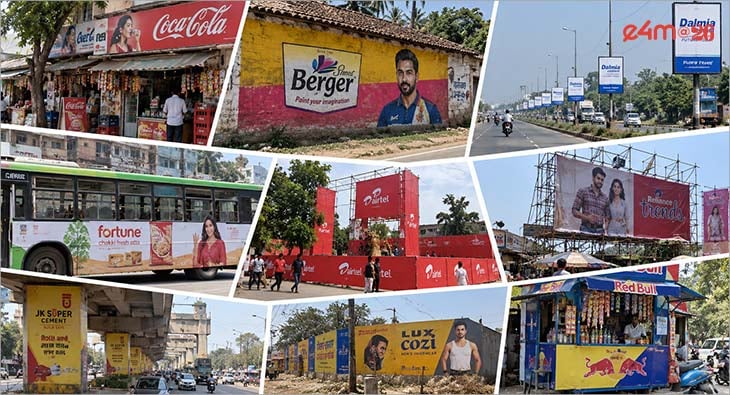
India's outdoor advertising market may be leaving a part of its business outside the industry's field of view. While premium hoardings, airport displays, metro networks and digital screens dominate the organised OOH conversation, a parallel ecosystem of local advertising operates across smaller towns, retail catchments, roadside locations and regional commercial centres.
Industry heads say the extent of such outdoor activity remains difficult to establish. For a medium seeking a larger share of brand budgets, that distinction matters. If local campaigns and smaller advertising networks are not consistently represented in market estimates, the industry could be working with an incomplete picture of where outdoor advertising money is being spent, which advertisers are driving demand and how opportunities beyond major cities should be evaluated.
"It is quite possible that the actual size of India’s OOH market is larger than what some industry estimates indicate. However, putting a number to that gap is difficult without a comprehensive assessment of both organised and unorganised media activity. I would be cautious about quoting a percentage until we have a consistent and independently validated basis for doing so," said Rohit Chopra, Deputy CEO of Times Innovative Media Ltd (Times OOH).
Beyond organised OOH
Outdoor advertising activity takes place across different scales, from large-format campaigns to individual placements serving local businesses. The way these campaigns are bought and recorded can vary, making it difficult to establish whether all expenditure is represented consistently in market estimates.
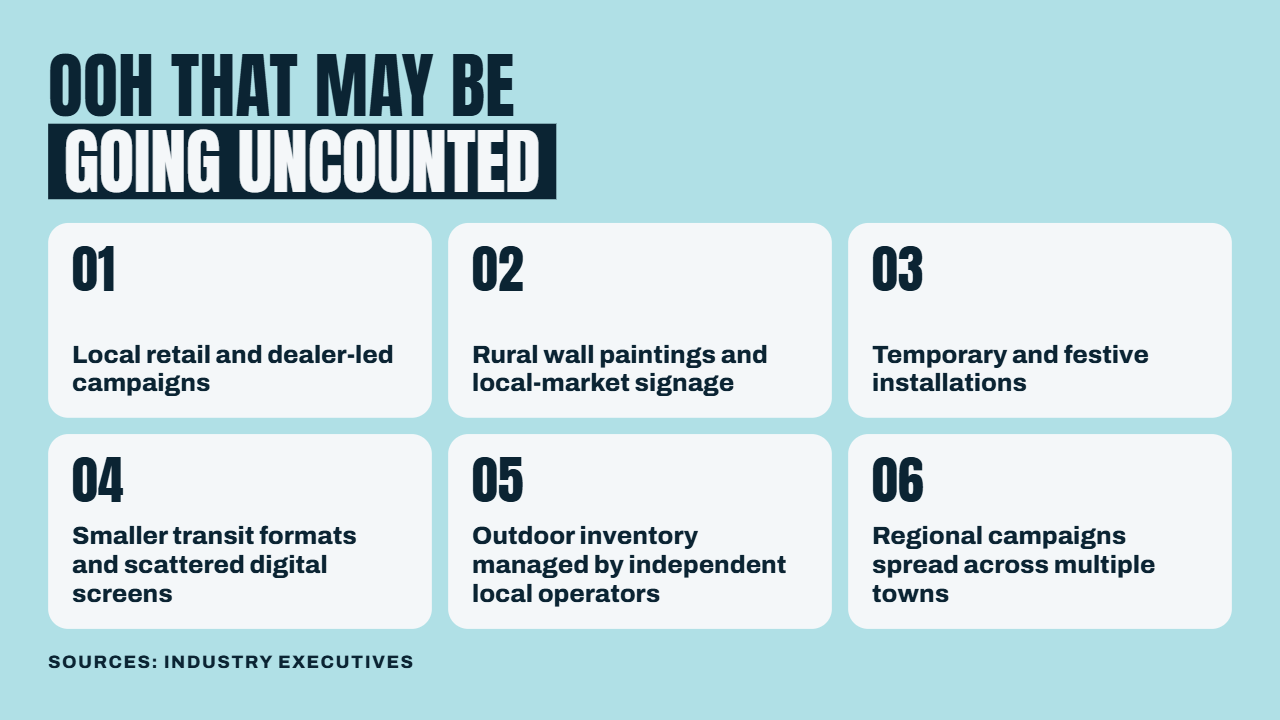
"I believe some spending does fall outside the reporting net, but I wouldn’t put a percentage to it without proper validation. Local retail campaigns, dealer-led advertising, rural wall paintings and short-term festive activity are areas worth examining. Existing estimates are useful benchmarks; the opportunity is to make their coverage more comprehensive. We also need to check whether some spending is already counted under activation or other budgets," said Jayesh Yagnik, Chief Executive Officer of MOMS Outdoor Media Solutions.
The reference to activation budgets also points to a classification issue. Before activity is counted as missing from an estimate, it is necessary to establish whether it has been excluded altogether or recorded under another category.
The way campaigns are spread across locations adds another layer to the exercise. A regional campaign may involve multiple placements rather than a single consolidated media buy.
"For example, a brand could run a regional campaign across roadside displays, local-market signage, retail areas and temporary branding across several towns. Each placement may serve a clear purpose, but the overall campaign spend may not be captured in one place," said Chopra.
For media owners, the challenge extends beyond individual placements to how information from different operators and markets is brought together.
"One of the challenges in assessing India’s OOH market is that advertising activity takes place across a wide range of formats, operators, and markets, not all of which may be represented consistently in industry estimates. Local-market advertising, temporary installations, and independently operated outdoor assets are areas that warrant closer examination when assessing the completeness of reported spending," said Fahim Batliwala, Chairman, Managing Director and Promoter of SIMCA Advertising Limited.
The six-city concentration
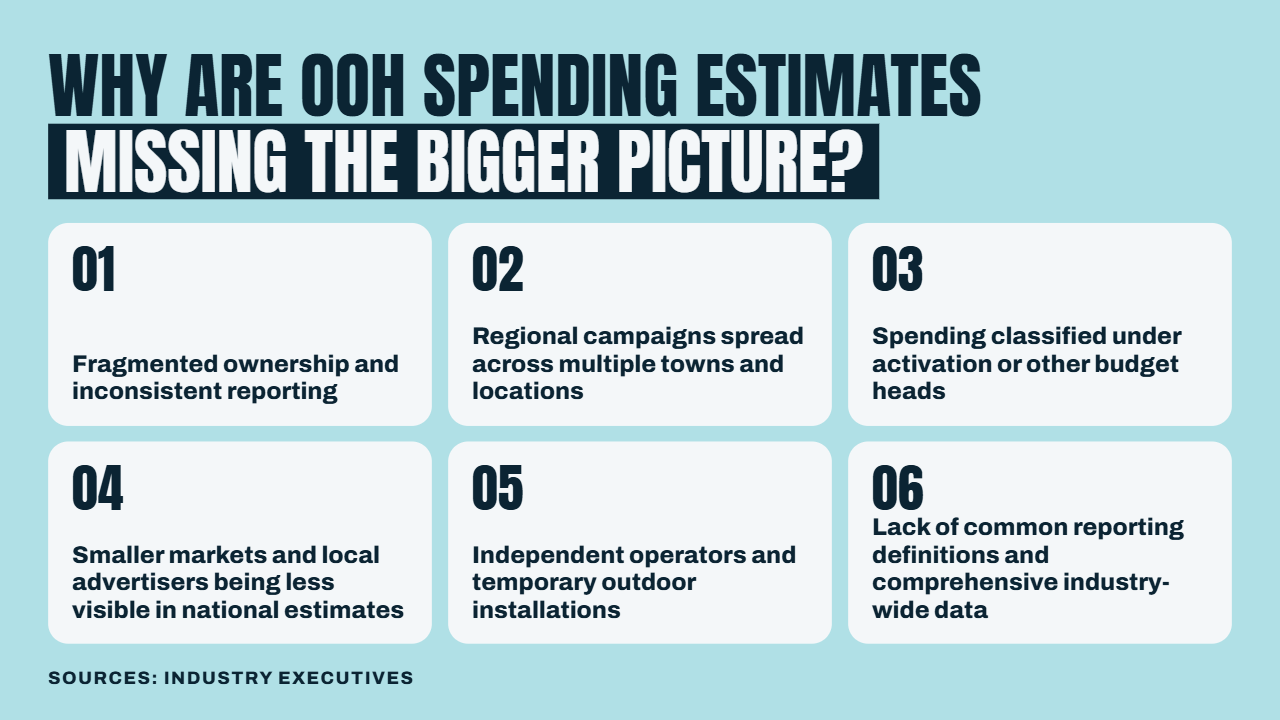
The concentration of reported OOH spending in India's top six cities is another dimension of the measurement question. Metropolitan markets have established advertising ecosystems and premium locations, while smaller cities have their own mix of national campaigns and local advertisers. The distribution of reported revenue does not, by itself, establish how much advertising activity takes place across each market.
"The concentration of reported spending in the largest cities is likely to reflect a combination of actual advertiser demand and the extent to which activity across different markets is captured. The largest cities have established advertising ecosystems, premium commercial locations, and a strong presence of national brands, so their prominence in spending estimates is understandable. However, reported market share alone does not tell us whether advertising activity elsewhere is being measured with the same degree of completeness," said Batliwala.
Revenue and activity also offer different ways of looking at the market. Premium locations in metropolitan areas command higher rates, while smaller advertisers may use local inventory to reach consumers in specific catchments.
"It’s probably a bit of both. Metros naturally attract national brands and command higher rates. But a higher share of revenue doesn’t necessarily mean a similar share of activity. Smaller markets have local businesses advertising, from jewellers and developers to coaching institutes and automobile dealers. Much of this happens directly with local owners and may be less visible in national estimates," said Yagnik.
Regional campaigns can also be distributed across multiple locations rather than concentrated in one large booking. This can make the aggregation of spending across markets more complex.
"Another factor is the way regional campaigns are planned. Instead of one large national campaign, activity may be spread across several smaller campaigns in different towns and cities. Individually, these investments may appear modest, but collectively, they represent a significant opportunity for the medium," said Chopra.
The fragmented ownership challenge
The structure of the OOH ecosystem is another factor in how expenditure is recorded. Inventory can be spread across operators with different reporting practices and measurement approaches, making it harder to consolidate information across locations and formats.
"The difficulty in measuring OOH comprehensively is not limited to a particular format. It also stems from the diversity of ownership structures, operating practices, and measurement approaches across the industry. Local outdoor inventory, temporary installations, and assets managed by smaller independent operators are worth examining because consolidating information across numerous participants can be challenging," said Batliwala.
The reporting challenge is not confined to static billboards. Smaller transit formats and networks of screens can also sit across different ownership structures, while the duration and scale of campaigns vary from one market to another.
"Local static sites, wall paintings, smaller transit formats and scattered screen networks deserve closer attention. Fragmented ownership and inconsistent reporting make this harder to capture. We need common definitions and greater participation from regional media owners, backed by simple, confidential reporting. The aim should be to arrive at a more complete, credible number that helps brands plan better and gives media owners confidence to invest," said Yagnik.
For industry estimates to become more comprehensive, participation from across the ecosystem would be necessary, alongside consistent definitions of what is being counted.
"The answer lies in better market documentation and wider industry participation. If media owners, agencies and industry bodies work towards more consistent reporting, we will have a clearer picture of the market’s true scale and be better placed to demonstrate its growth," said Chopra.
The quality of market data also has implications for how advertisers evaluate outdoor media. Comparing inventory across locations involves more than the physical presence of a hoarding or screen. Audience movement, campaign duration and the information available about the audiences reached can influence how an asset is assessed.
The missing number is only the beginning
The size of India's potential OOH measurement gap remains unquantified. Local campaigns, temporary installations and independently operated outdoor assets are among the areas industry executives have identified for closer examination, while differences in ownership structures and reporting practices add complexity to the exercise.
Until the industry can distinguish between unrecorded spending, differently classified activity and actual differences in regional demand, the size of the blind spot will remain an open question. A more comprehensive picture could help advertisers and media owners better understand the scale of outdoor advertising activity beyond the major cities, while giving the industry a stronger basis for assessing its overall market size.
Read more news about Out of Home, Internet Advertising, Marketing, Digital Media, TV Media
For more updates, be socially connected with us onInstagram, LinkedIn, Twitter, Facebook, YouTube & Google News